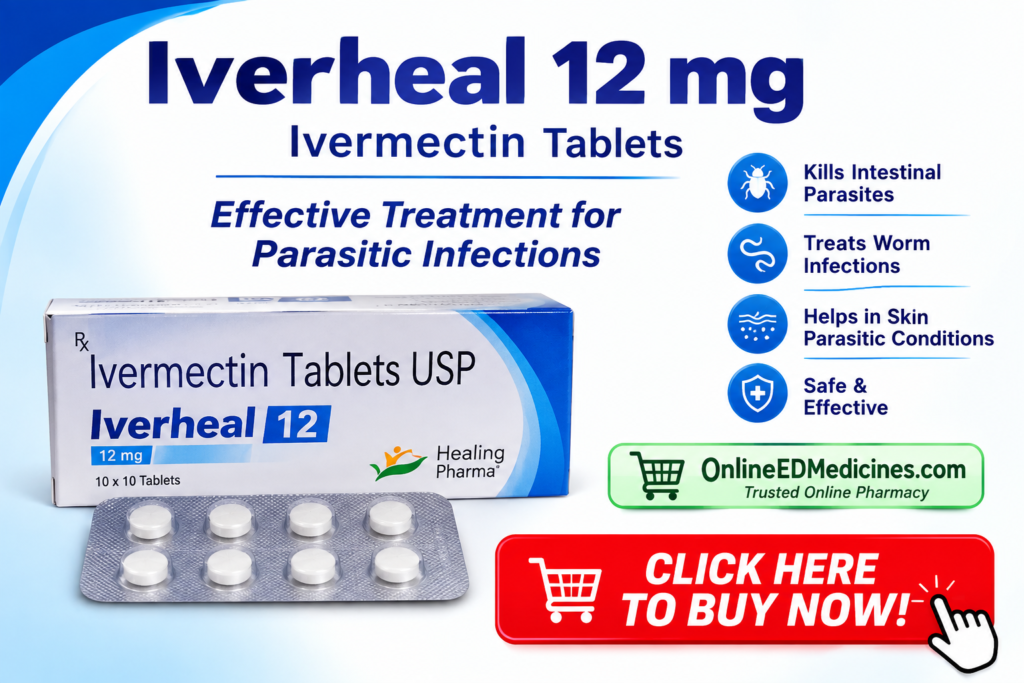
What Is Ivermectin Iverheal 12 mg?
Iverheal 12 mg is an oral medicine containing ivermectin 12 mg, an antiparasitic drug used to treat certain parasitic infections. Ivermectin belongs to a group of medicines called anthelmintics and works by interfering with the nervous system and muscle function of susceptible parasites, helping the body eliminate them.
Iverheal 12 mg may be prescribed for specific parasitic conditions such as strongyloidiasis and onchocerciasis. In some clinical settings, ivermectin is also used for other parasitic infestations, such as scabies, according to local treatment guidelines and medical judgment.
The correct dose of ivermectin depends on the condition being treated, body weight, age, medical history, and other individual factors. Therefore, Iverheal 12 mg should be used only according to the directions provided by a qualified healthcare professional.
This guide explains what Iverheal 12 mg is, what it is used for, how ivermectin works, how it is taken, possible side effects, precautions, drug interactions, and frequently asked questions.
What Is Iverheal 12 mg?
Iverheal 12 mg is a tablet containing 12 mg of ivermectin. It is an antiparasitic medicine intended to treat certain infections caused by parasites.
Unlike antibiotics, which are primarily used against bacterial infections, ivermectin is designed to act against susceptible parasites. Depending on the infection and local medical guidelines, ivermectin may be prescribed for intestinal parasites, certain worm infections, and some parasitic skin conditions.
Iverheal 12 mg is not a medicine for erectile dysfunction and should not be confused with medicines such as Viagra or other PDE5 inhibitors.
The strength of 12 mg does not mean that every person should take one 12 mg tablet. Ivermectin dosing is commonly determined according to body weight and the specific infection being treated. A healthcare professional can determine the appropriate dose and treatment schedule.
What Is Ivermectin?
Ivermectin is an antiparasitic medicine that has been used for several decades to treat particular parasitic infections in humans. It belongs to the avermectin family of medicines.
Ivermectin works primarily by affecting certain chloride channels in susceptible parasites. This interferes with normal nerve and muscle activity, eventually causing paralysis and death of the parasite.
Because ivermectin targets specific biological processes in parasites, it can be effective against certain worms and other parasites when used for an appropriate medical indication.
However, ivermectin is not effective against every type of infection. It should be used for conditions for which a healthcare professional has determined that ivermectin is appropriate.
What Is Iverheal 12 mg Used For?
Iverheal 12 mg may be prescribed for certain parasitic infections. Some established medical uses of oral ivermectin include:
Strongyloidiasis
Strongyloidiasis is an intestinal infection caused by the parasitic roundworm Strongyloides stercoralis.
Ivermectin is commonly used to treat strongyloidiasis. The treatment schedule depends on the individual’s condition and medical guidance.
People with weakened immune systems may be at increased risk of severe or complicated strongyloidiasis, making appropriate diagnosis and treatment particularly important.
Onchocerciasis
Onchocerciasis, also known as river blindness, is a parasitic disease caused by Onchocerca volvulus. It is transmitted through the bites of infected blackflies.
Ivermectin can be used to reduce the number of microfilariae, which are immature forms of the parasite, and help control symptoms and transmission.
Treatment programs for onchocerciasis may involve repeated doses according to established medical or public-health guidelines.
Scabies
Scabies is a contagious skin infestation caused by the mite Sarcoptes scabiei.
Oral ivermectin may be prescribed for scabies in certain circumstances, including situations where topical treatment may not be suitable or where outbreaks require particular management. Its approval and recommended use for scabies can vary between countries.
Scabies treatment may also require treatment of close contacts and environmental measures to reduce the chance of reinfestation.
Other Parasitic Conditions
Depending on local guidelines and clinical judgment, ivermectin may sometimes be used for other parasitic conditions. Such use should be determined by a qualified healthcare professional rather than by self-treatment.
How Does Iverheal 12 mg Work?
The active ingredient in Iverheal 12 mg is ivermectin.
Ivermectin interacts with specific glutamate-gated chloride channels found in susceptible parasites. These channels play an important role in nerve and muscle function.
When ivermectin affects these channels, it increases the movement of chloride ions across the parasite’s cell membranes. This disrupts normal nerve and muscle activity.
As a result, susceptible parasites become immobilized and eventually die or are cleared from the body.
The exact clinical effect depends on the parasite, the infection being treated, and the prescribed treatment regimen.
How Should Iverheal 12 mg Be Taken?
Iverheal 12 mg should be taken exactly as instructed by your doctor or pharmacist.
The dose is not necessarily the same for every patient. Ivermectin dosing can depend on:
- The type of parasitic infection
- Body weight
- Age
- Overall health
- Other medicines being taken
- The severity of the infection
- Whether additional doses are required
For some approved uses, oral ivermectin is taken as a single dose on an empty stomach with water. However, dosing instructions can differ according to the condition and local prescribing information.
Do not assume that one 12 mg tablet is automatically the correct dose for you.
Do not increase the dose, repeat treatment, or take ivermectin more frequently than recommended by your healthcare professional.
Can Iverheal 12 mg Be Taken Every Day?
Iverheal 12 mg should not normally be taken every day unless a healthcare professional specifically instructs you to do so.
Ivermectin treatment schedules vary according to the condition being treated. Some conditions may require a single dose, while others may require additional doses at specific intervals.
Taking ivermectin unnecessarily or more frequently than recommended can increase the risk of adverse effects.
Always follow the prescribed treatment schedule rather than using Iverheal 12 mg as a daily medicine on your own.
Iverheal 12 mg Dosage
There is no single standard ivermectin dose that applies to everyone.
For some infections, ivermectin dosing is calculated according to body weight. The recommended amount can also vary depending on the parasite and treatment guidelines.
For this reason, the 12 mg strength should not be interpreted as a universal dose.
Your healthcare professional may consider your body weight, diagnosis, medical history, and other factors before recommending the appropriate amount.
If you are unsure about your dose, ask your doctor or pharmacist before taking the medicine.
What If You Miss a Dose?
What you should do after missing an ivermectin dose depends on the treatment schedule you were given.
If your treatment involves a scheduled dose and you forget to take it, contact your healthcare professional or pharmacist for advice.
Do not automatically take an extra tablet to compensate for a missed dose unless you have been specifically instructed to do so.
What Happens If You Take Too Much Iverheal 12 mg?
Taking more ivermectin than prescribed can increase the risk of adverse effects.
Possible symptoms of excessive ivermectin exposure may include:
- Nausea
- Vomiting
- Dizziness
- Weakness
- Drowsiness
- Confusion
- Loss of coordination
- Low blood pressure
- Seizures
- Breathing difficulties
If you accidentally take more Iverheal 12 mg than prescribed, seek medical advice promptly. Severe symptoms require urgent medical attention.
Do not wait for symptoms to become severe before seeking help.
Common Side Effects of Iverheal 12 mg
Like other medicines, ivermectin can cause side effects, although not everyone experiences them.
Depending on the condition being treated, possible side effects can include:
- Nausea
- Diarrhea
- Stomach discomfort
- Dizziness
- Headache
- Weakness
- Fatigue
- Skin rash or itching
Some reactions can also occur because parasites are dying and the body’s immune response is changing.
If side effects are severe, persistent, or concerning, contact your healthcare professional.
Serious Side Effects
Serious reactions to ivermectin are uncommon but can occur.
Seek urgent medical attention if you experience symptoms such as:
- Severe dizziness or fainting
- Confusion or changes in consciousness
- Seizures
- Difficulty breathing
- Severe skin reactions
- Significant swelling
- Loss of coordination
- Severe weakness
People being treated for certain parasitic infections may also experience reactions related to the death of parasites, particularly when there is a high parasite burden.
Who Should Be Careful With Iverheal 12 mg?
Iverheal 12 mg may not be suitable for everyone.
Tell your doctor if you:
- Are pregnant or planning to become pregnant
- Are breastfeeding
- Have liver problems
- Have a weakened immune system
- Have a neurological condition
- Take medicines that may interact with ivermectin
- Have previously experienced an allergic reaction to ivermectin
- May have been exposed to Loa loa
Certain patients may require additional assessment before treatment.
Children should receive ivermectin only when it is appropriate for their age and body weight and when recommended by a healthcare professional.
Iverheal 12 mg During Pregnancy
If you are pregnant, planning pregnancy, or think you may be pregnant, speak with your doctor before taking ivermectin.
The decision to use ivermectin during pregnancy depends on the potential benefits and risks and the condition being treated.
Do not start or stop treatment during pregnancy without professional medical advice.
Iverheal 12 mg and Breastfeeding
If you are breastfeeding, tell your doctor before using ivermectin.
Your healthcare professional can consider the available safety information, the dose, and the condition being treated before deciding whether ivermectin is appropriate.
Iverheal 12 mg Drug Interactions
Ivermectin may interact with certain medicines.
Before taking Iverheal 12 mg, tell your doctor or pharmacist about all medicines you use, including:
- Prescription medicines
- Over-the-counter medicines
- Vitamins
- Herbal products
- Dietary supplements
This is particularly important if you take medicines that may affect ivermectin metabolism or increase the risk of adverse effects.
Do not start a new medicine or supplement without checking whether it is compatible with your current treatment.
Can I Take Iverheal 12 mg With Food?
Instructions regarding food can depend on the specific ivermectin product and indication.
Some oral ivermectin prescribing information recommends taking the medicine on an empty stomach with water.
Always follow the instructions provided with your medicine or by your healthcare professional rather than changing the way you take it yourself.
Iverheal 12 mg and Alcohol
If you are taking Iverheal 12 mg, discuss alcohol use with your doctor or pharmacist.
Alcohol may worsen symptoms such as dizziness or drowsiness in some people. Avoid activities such as driving if you feel dizzy, weak, sleepy, or otherwise impaired after taking the medicine.
Can Iverheal 12 mg Treat COVID-19?
Ivermectin should not be used as a treatment for COVID-19 unless it is being used for a separate medical condition for which it has been prescribed.
Ivermectin is an antiparasitic medicine and should not be self-administered to prevent or treat viral infections without appropriate medical advice.
Using higher-than-recommended doses for an unapproved purpose can be dangerous.
Is Iverheal 12 mg the Same as Viagra?
No. Iverheal 12 mg and Viagra are completely different medicines.
Iverheal 12 mg contains ivermectin and is used for certain parasitic infections.
Viagra contains sildenafil and is used to treat erectile dysfunction.
They have different active ingredients, mechanisms, indications, and dosing instructions.
Iverheal 12 mg should never be used as a substitute for Viagra or another erectile dysfunction medicine.
Iverheal 12 mg vs Iverheal 6 mg
Both Iverheal 6 mg and Iverheal 12 mg contain ivermectin, but they contain different amounts of the active ingredient.
The appropriate strength depends on the prescribed dose, which may be determined according to body weight and the infection being treated.
A higher-strength tablet is not automatically better or more effective. Taking the wrong strength can result in an incorrect dose.
Your healthcare professional should determine which strength is appropriate.
How Long Does Iverheal 12 mg Take to Work?
The time required for ivermectin to produce a noticeable clinical effect varies depending on the infection being treated.
For some parasitic infections, the medicine begins affecting susceptible parasites after treatment, but symptoms may take longer to improve.
In conditions such as scabies, itching may continue for some time even after successful treatment because the skin can remain irritated.
Do not automatically repeat the dose simply because symptoms have not disappeared immediately.
How Should Iverheal 12 mg Be Stored?
Store Iverheal 12 mg according to the instructions provided on the product packaging.
In general:
- Keep tablets in their original packaging.
- Store them away from excessive heat and moisture.
- Keep the medicine away from children and pets.
- Do not use tablets after the expiration date.
- Dispose of unwanted medicine according to local pharmacy or healthcare guidance.
Important Safety Information
Iverheal 12 mg should be used only for an appropriate medical indication.
Do not self-medicate based solely on internet information. The correct ivermectin dose depends on the condition, body weight, age, and other individual factors.
Do not use veterinary ivermectin products as substitutes for medicines intended for humans. Veterinary formulations can have different concentrations, inactive ingredients, and dosing instructions.
If you develop serious symptoms after taking ivermectin, seek immediate medical attention.
Frequently Asked Questions About Iverheal 12 mg
What is Iverheal 12 mg used for?
Iverheal 12 mg contains ivermectin and is used to treat certain parasitic infections. Depending on the clinical indication and local guidelines, it may be used for infections such as strongyloidiasis and onchocerciasis and, in some circumstances, scabies.
Is Iverheal 12 mg the same as Viagra?
No. Iverheal 12 mg contains ivermectin and is an antiparasitic medicine. Viagra contains sildenafil and is used for erectile dysfunction. They have completely different purposes.
How should Iverheal 12 mg be taken?
Take Iverheal 12 mg exactly as prescribed. The dose and treatment schedule depend on the infection and individual factors such as body weight. Do not change the dose without medical advice.
Can I take Iverheal 12 mg every day?
No, not unless your healthcare professional specifically prescribes a daily schedule. Ivermectin is not automatically intended for daily use.
Can Iverheal 12 mg be taken on an empty stomach?
Some oral ivermectin instructions recommend taking it on an empty stomach with water. Follow the instructions provided with your specific medicine and your healthcare professional’s advice.
Is Iverheal 12 mg an antibiotic?
No. Iverheal 12 mg contains ivermectin, an antiparasitic medicine. It is not an antibiotic used to treat bacterial infections.
Can everyone take Iverheal 12 mg?
No. Certain people may require special precautions, including pregnant or breastfeeding individuals, children below the appropriate weight, people with certain medical conditions, and those taking interacting medicines.
What should I do if I take too much Iverheal 12 mg?
Contact a healthcare professional or seek urgent medical assistance, especially if you develop dizziness, confusion, weakness, coordination problems, seizures, breathing difficulties, or other serious symptoms.
Can I use Iverheal 12 mg for viral infections?
Ivermectin should not be used to self-treat viral infections. It should be taken only for an appropriate indication recommended by a qualified healthcare professional.
Final Thoughts on Iverheal 12 mg
Iverheal 12 mg is an ivermectin-containing antiparasitic medicine used for certain parasitic infections. Its effectiveness depends on using the correct dose for the specific condition and following an appropriate treatment schedule.
The medicine may be prescribed for conditions such as strongyloidiasis and onchocerciasis and may be used for certain other parasitic conditions depending on local guidelines and clinical circumstances.
Because ivermectin dosing is not the same for everyone, patients should avoid self-dosing or taking Iverheal 12 mg every day without medical advice. It is also important to inform a healthcare professional about existing medical conditions and other medicines being used.
Understanding what Iverheal 12 mg is, what it is used for, how it works, and what precautions apply can help patients use the medicine more safely and appropriately.
Medical Disclaimer: This article is provided for general educational purposes and is not a substitute for professional medical advice, diagnosis, or treatment. Always consult a qualified doctor or pharmacist before starting, stopping, or changing ivermectin treatment. Iverheal 12 mg should be used according to the product information and applicable local medical guidance.