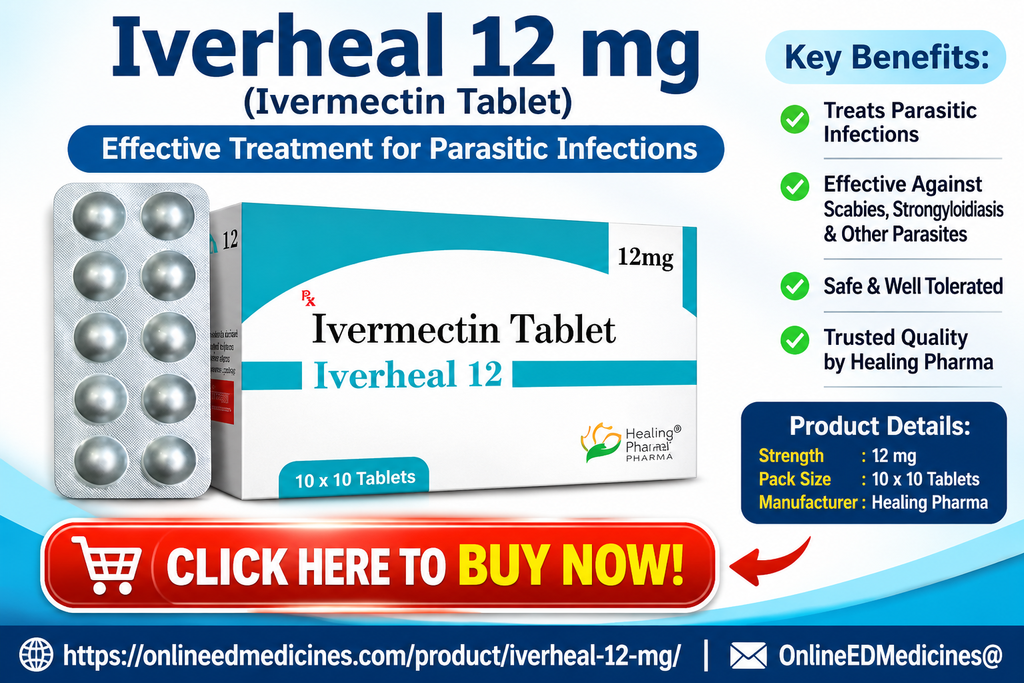
Iverheal 12 mg Ivermectin
Parasitic infections can affect different parts of the human body, including the digestive system, skin, and other tissues. Appropriate diagnosis and treatment are important for managing these infections and preventing potential complications. Iverheal 12 mg is an oral medication containing ivermectin, an antiparasitic ingredient used to treat certain parasitic infections under medical supervision.
Iverheal 12 mg Ivermectin Tablets are manufactured by Healing Pharma India Pvt. Ltd. Each tablet contains 12 mg of ivermectin as its active ingredient. This medicine belongs to a class of medications known as anthelmintics, which work against certain parasitic organisms.
Understanding the uses, working mechanism, precautions, and possible side effects of Iverheal 12 mg can help patients make informed decisions with guidance from qualified healthcare professionals.
This comprehensive Iverheal 12 mg guide covers its product composition, therapeutic applications, benefits, dosage considerations, safety information, and frequently asked questions.
What Is Iverheal 12 mg?
Iverheal 12 mg is an antiparasitic prescription medication containing ivermectin 12 mg. It is designed to help treat certain infections caused by susceptible parasites.
Ivermectin works by interfering with the nervous system and muscle function of susceptible parasites. This action can cause paralysis and eventually eliminate the parasites responsible for particular infections.
The medicine should only be used for conditions for which a healthcare professional considers ivermectin appropriate.
Product Information
- Product Name: Iverheal 12 mg
- Active Ingredient: Ivermectin
- Strength: 12 mg per tablet
- Drug Category: Antiparasitic / Anthelmintic
- Dosage Form: Oral tablet
- Manufacturer: Healing Pharma India Pvt. Ltd.
- Administration: Oral
- Prescription Requirement: Use under medical supervision
Uses of Iverheal 12 mg Ivermectin Tablets
Ivermectin is used in the management of specific parasitic infections. The exact application depends on the patient’s diagnosis, medical history, and the prescribing healthcare professional’s assessment.
Some established medical applications of oral ivermectin include:
1. Treatment of Strongyloidiasis
Strongyloidiasis is an intestinal infection caused by the parasitic roundworm Strongyloides stercoralis.
The infection can cause symptoms such as abdominal discomfort, diarrhoea, nausea, and skin irritation. Some individuals may experience few or no noticeable symptoms.
Ivermectin is an established treatment for intestinal strongyloidiasis. It acts against susceptible parasites and helps the body eliminate the infection.
2. Management of Onchocerciasis
Onchocerciasis, commonly called river blindness, is a parasitic disease caused by Onchocerca volvulus.
The infection may affect the skin and eyes and can lead to serious vision complications.
Ivermectin helps control the developing parasitic forms responsible for the disease. However, it does not eliminate adult Onchocerca worms, so medical monitoring and an appropriate treatment programme are important.
3. Other Parasitic Conditions
Healthcare professionals may sometimes prescribe ivermectin for selected other parasitic conditions, depending on clinical evidence and local treatment guidelines.
Certain conditions, including scabies and other parasitic infestations, may require different treatment approaches. Oral ivermectin may be considered in selected cases, but its use should be determined by a qualified medical professional.
How Does Iverheal 12 mg Work?
The active ingredient in Iverheal 12 mg is ivermectin, which acts on specific nerve and muscle functions in susceptible parasites.
It interacts with glutamate-gated chloride channels found in invertebrate nerve and muscle cells.
This interaction increases chloride ion movement across cell membranes, resulting in paralysis of the susceptible parasites.
Once the parasites become immobilised, their ability to survive and maintain normal biological functions is disrupted.
The human body can then eliminate affected parasites through its natural processes.
Key Working Mechanism
- Ivermectin interacts with specific parasite ion channels.
- It interferes with normal nerve and muscle activity.
- Susceptible parasites become paralysed.
- Their survival and normal functioning are disrupted.
- The body gradually eliminates the affected parasites.
This selective mechanism explains why ivermectin is used in treating certain parasitic infections.
Benefits of Iverheal 12 mg Ivermectin
When prescribed for an appropriate medical condition, ivermectin offers several therapeutic advantages.
1. Antiparasitic Action
Ivermectin targets susceptible parasites by interfering with their nervous system and muscle functions.
2. Established Treatment Option
Oral ivermectin has an established role in treating certain parasitic infections, particularly strongyloidiasis and onchocerciasis.
3. Convenient Oral Administration
Iverheal 12 mg is available as an oral tablet, making administration straightforward when following a healthcare professional’s instructions.
4. Targeted Therapeutic Activity
Ivermectin acts on specific biological targets in susceptible parasites rather than functioning as a general-purpose antimicrobial medicine.
5. Physician-Guided Treatment
The availability of different ivermectin strengths allows healthcare professionals to select an appropriate formulation based on individual treatment requirements.
Important: These benefits apply only when ivermectin is prescribed for an appropriate condition. It is not a general immunity booster or a treatment for every type of infection.
Iverheal 12 mg Dosage and Administration
The appropriate ivermectin dosage depends on several factors, including:
- The type of parasitic infection.
- The patient’s body weight.
- The severity of the infection.
- Overall health and medical history.
- Other medications being taken.
- The healthcare professional’s treatment plan.
A 12 mg tablet does not mean that every patient should take one tablet. Ivermectin dosing is often weight-based and varies according to the condition being treated.
Important Administration Guidelines
- Take Iverheal 12 mg only when prescribed by a qualified healthcare professional.
- Follow the prescribed dose and administration instructions.
- Do not increase or repeat the dose without medical advice.
- Do not share your medication with another person.
- Contact your healthcare professional if you miss a prescribed dose.
- Attend recommended follow-up appointments to evaluate treatment effectiveness.
Some oral ivermectin treatment regimens involve administration on an empty stomach with water. However, follow the instructions provided for your specific prescription.
Possible Side Effects of Iverheal 12 mg
Like other medicines, ivermectin may cause side effects in some individuals.
The type and severity of side effects can vary depending on the patient’s condition, dosage, and individual response to treatment.
Commonly Reported Side Effects
Some possible side effects include:
- Nausea
- Vomiting
- Diarrhoea
- Dizziness
- Abdominal discomfort
- Loss of appetite
- Weakness
- Constipation
These effects may be temporary, but patients should contact their healthcare professional if symptoms persist or become troublesome.
Serious Side Effects
Although uncommon, serious reactions may occur.
Seek immediate medical attention if you experience:
- Severe skin rash or blistering.
- Swelling of the face, lips, or throat.
- Difficulty breathing.
- Severe confusion or unusual drowsiness.
- Seizures.
- Significant problems with coordination or balance.
Do not ignore unusual symptoms after taking ivermectin.
Precautions Before Taking Iverheal 12 mg
Before beginning treatment, discuss your medical history and current medications with your healthcare professional.
1. Pregnancy and Breastfeeding
If you are pregnant, planning pregnancy, or breastfeeding, consult your healthcare professional before using ivermectin.
The potential benefits and risks should be evaluated individually.
2. Existing Medical Conditions
Inform your doctor if you have liver problems, immune system disorders, or other significant medical conditions.
These factors may influence the suitability of ivermectin treatment.
3. Medication Interactions
Tell your healthcare professional about all prescription medicines, non-prescription products, vitamins, and herbal supplements you use.
Certain medicines, including blood-thinning medications such as warfarin, may require additional monitoring.
4. Allergic Reactions
Do not take ivermectin if you have a known allergy to ivermectin or any ingredient in the formulation without medical advice.
5. Children
Ivermectin treatment in children requires careful medical assessment, including consideration of body weight and the specific infection.
6. Avoid Veterinary Products
Never substitute veterinary ivermectin products for human prescription medication. Animal formulations may differ significantly and can be dangerous when used by humans.
Is Iverheal 12 mg Effective for COVID-19?
Ivermectin should not be considered a proven treatment or preventive medicine for COVID-19.
The US Food and Drug Administration has not authorised or approved ivermectin for preventing or treating COVID-19 in humans.
Patients should follow established medical recommendations and consult qualified healthcare professionals for appropriate COVID-19 prevention and treatment options.
Iverheal 12 mg should be used only for an appropriate medical indication.
Storage Instructions for Iverheal 12 mg
Proper storage helps maintain the quality of pharmaceutical products.
Follow the storage instructions printed on the medicine packaging.
General precautions include:
- Store below the temperature specified on the product label.
- Protect tablets from moisture.
- Keep the medicine in its original packaging.
- Avoid direct sunlight and excessive heat.
- Keep medicines away from children and pets.
- Do not use tablets beyond their expiry date.
Check the packaging before use and consult a pharmacist if the tablets appear damaged or have changed in appearance.
Why Is Medical Guidance Important When Using Ivermectin?
Although ivermectin is an established antiparasitic medicine, its suitability depends on the specific infection and the patient’s individual circumstances.
Self-medication may result in incorrect dosing, unnecessary exposure to side effects, or delayed treatment of the actual medical condition.
A qualified healthcare professional can:
- Identify the underlying parasitic infection.
- Determine whether ivermectin is appropriate.
- Calculate the correct dose based on clinical requirements.
- Evaluate possible medication interactions.
- Monitor treatment progress.
- Recommend additional investigations when necessary.
Responsible medicine use is essential for achieving appropriate treatment outcomes.
Frequently Asked Questions About Iverheal 12 mg
1. What is Iverheal 12 mg used for?
Iverheal 12 mg contains ivermectin, an antiparasitic medicine used for certain parasitic infections. Its use should be based on an appropriate diagnosis and a healthcare professional’s prescription.
2. What is the active ingredient in Iverheal 12 mg?
The active ingredient is ivermectin, with each tablet containing 12 mg of ivermectin.
3. How does Iverheal 12 mg work?
Ivermectin interferes with specific nerve and muscle functions in susceptible parasites. This causes paralysis and disrupts their ability to survive.
4. Is Iverheal 12 mg an antibiotic?
No. Iverheal 12 mg is an antiparasitic medicine, not an antibiotic. Antibiotics are used against susceptible bacterial infections, whereas ivermectin targets certain parasites.
5. Can I take Iverheal 12 mg without a prescription?
No. You should not self-medicate with ivermectin. Consult a qualified healthcare professional to determine whether it is suitable for your condition.
6. Does Iverheal 12 mg treat COVID-19?
Ivermectin is not an approved or established treatment for COVID-19. It should not be used for COVID-19 prevention or treatment without an evidence-based medical indication.
7. What are the common side effects of ivermectin?
Possible side effects include nausea, diarrhoea, vomiting, dizziness, abdominal discomfort, and weakness. Serious reactions require immediate medical attention.
8. How should I store Iverheal 12 mg tablets?
Store the tablets according to the manufacturer’s instructions, protect them from moisture, and keep them away from children.
9. Can I repeat the dose if my symptoms continue?
Do not repeat the dose independently. Persistent symptoms require medical reassessment to determine whether additional treatment or further investigations are necessary.
10. Is Iverheal 12 mg suitable for everyone?
No. Suitability depends on the patient’s age, weight, medical history, pregnancy or breastfeeding status, and the type of infection. Medical assessment is essential.
Conclusion
Iverheal 12 mg Ivermectin is an oral antiparasitic formulation containing 12 mg of ivermectin per tablet. Ivermectin has an established medical role in treating certain parasitic infections, including intestinal strongyloidiasis and onchocerciasis.
Its targeted mechanism of action helps disrupt the nervous system and muscle functions of susceptible parasites. However, appropriate diagnosis, correct dosing, medical supervision, and follow-up are essential for safe treatment.
Before using Iverheal 12 mg, consult a qualified healthcare professional and follow the prescribed instructions. Responsible use helps minimise avoidable risks and supports appropriate management of parasitic infections.
Medical Disclaimer: This article is intended for general educational and informational purposes only. It does not replace professional medical advice, diagnosis, or treatment. Iverheal 12 mg should be used only under appropriate medical supervision and according to a valid prescription.